

The County Integrated Development Plan Path to Progress provides a clear roadmap for sustainable growth, improved services, and stronger communities. It aligns county priorities with real needs, ensuring resources are used effectively. This plan creates a focused direction that supports development for both present and future generations.
What Is a County Integrated Development Plan?
A county integrated development plan (CIDP) is a legally mandated five-year blueprint that every county government in Kenya must prepare and have approved before it can allocate or spend public funds. It sets out a county’s development priorities, programmes, flagship projects, resource mobilisation strategy, and monitoring framework for one governor’s term of office.
That last part matters more than most people realise
The CIDP isn’t advisory. Sections 104 and 108 of the County Government Act, 2012 make it a hard legal prerequisite: no county can appropriate funds not for roads, not for hospitals, not for staff salaries without an approved planning framework anchored in a valid CIDP. Kenya’s 47 counties collectively received KSh 384 billion in transfers in FY 2023/24, per the National Treasury’s October 2024 public statement. Every shilling of that was supposed to flow through a CIDP-backed budget structure.
The Legal Foundation: Where the Obligation Comes From
Most people who land on a CIDP PDF assume it’s a policy wish-list. It isn’t.
Three pieces of legislation create the binding framework:
- Constitution of Kenya, 2010: Article 220(2) requires county governments to prepare development plans that include strategic priorities for the medium term
- County Government Act, 2012: Section 108 requires a five-year integrated development plan as the basis for fund appropriation; Section 104 makes planning a core function of the county executive
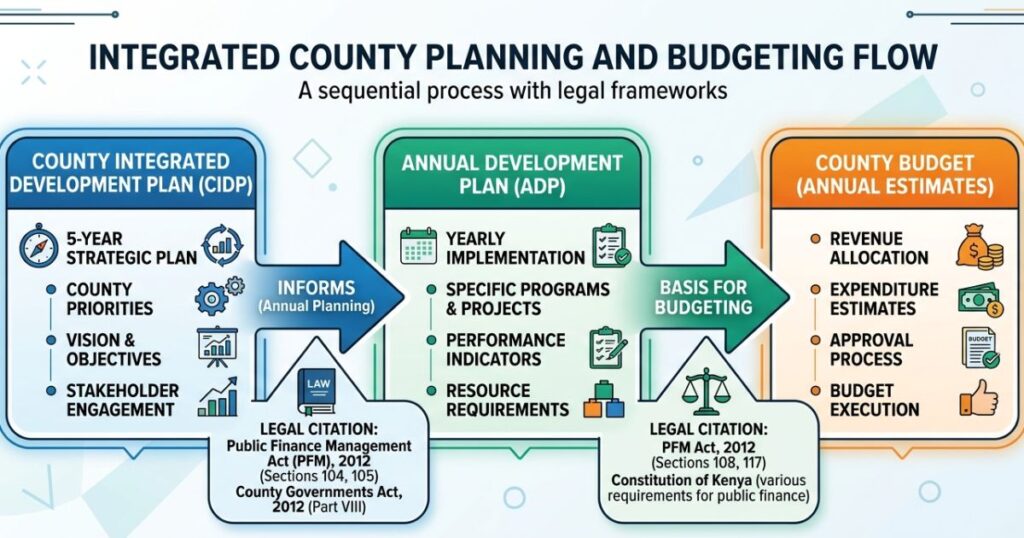
- Public Finance Management Act, 2012: Section 126 requires that annual development plans (ADPs) flow directly from the CIDP, and that no county budget is prepared outside this chain
What most guides skip is the PFM Act’s role. The County Government Act creates the obligation to plan. The PFM Act creates the enforcement mechanism — because without a CIDP, no annual budget can be legally approved, and without an approved budget, the Controller of Budget won’t release equitable share disbursements.
Read more: County Government Act 2012 summary
How a CIDP Is Structured: The Six-Chapter Standard
Kenya’s State Department for Planning published the Third Generation CIDP Guidelines in August 2022, covering the 2023–2027 cycle. These guidelines don’t just recommend structure they set norms and standards that all 47 counties are expected to follow to ensure uniformity across documents.
Here’s the standard six-chapter structure those guidelines prescribe
Chapter 1 — County Overview: Background profile: geography, demographics (2019 Census data is the baseline), agro-ecological zones, major economic activities, and inter-county relations. This chapter anchors everything that follows. If a county’s development issues aren’t grounded in real population and resource data, the rest of the plan drifts into generality.
Chapter 2 — Performance Review of the Previous CIDP: Analysis of what actually happened during the preceding five-year cycle revenue collected vs. projected, development expenditure absorption rates, project completion, and honestly documented challenges. The IBP Kenya guide (more on this shortly) argues this chapter is the most revealing: counties that skip hard truths here tend to repeat the same failures.
Chapter 3 — Spatial Development Framework: Maps and frameworks for how physical space will be used growth zones, infrastructure corridors, environmental conservation areas. This chapter links the CIDP to county spatial plans and city/municipal plans.
Chapter 4 — Sector Development Priorities: The core of the document. This is where programmes, flagship projects, and cross-sectoral linkages live. The August 2022 guidelines specifically require that this chapter reflect alignment with the Fourth Medium Term Plan (MTP IV) 2023–2027, Kenya Vision 2030, the SDGs, Africa’s Agenda 2063, and the Paris Agreement on climate change.
Chapter 5 — Implementation Framework: Institutional arrangements (which department owns what), resource mobilisation strategy, own-source revenue (OSR) targets, asset management, and risk mitigation. This chapter is where realistic counties separate themselves from aspirational ones — vague institutional language here usually means project failure later.
Chapter 6 — Monitoring and Evaluation Framework: Targets, indicators, reporting timelines, and oversight mechanisms. A CIDP without a credible M&E chapter is a plan with no accountability architecture.
Quick note: the six-chapter structure above applies to county executive CIDPs. County assemblies prepare their own CIDPs same legal obligation, slightly different functional scope.
CIDP vs. Annual Development Plan vs. County Budget: The Chain Most People Confuse
Quick Comparison
| Document | Timeframe | Legal Trigger | Primary Purpose |
| CIDP | 5 years | County Government Act, S.108 | Sets strategic priorities and flagship projects |
| Annual Development Plan (ADP) | 1 year | PFM Act, S.126 | Translates CIDP year-by-year into programmes |
| County Fiscal Strategy Paper (CFSP) | 1 year | PFM Act | Sets medium-term fiscal framework |
| County Budget Estimates | 1 year | PFM Act | Appropriates funds against ADP priorities |
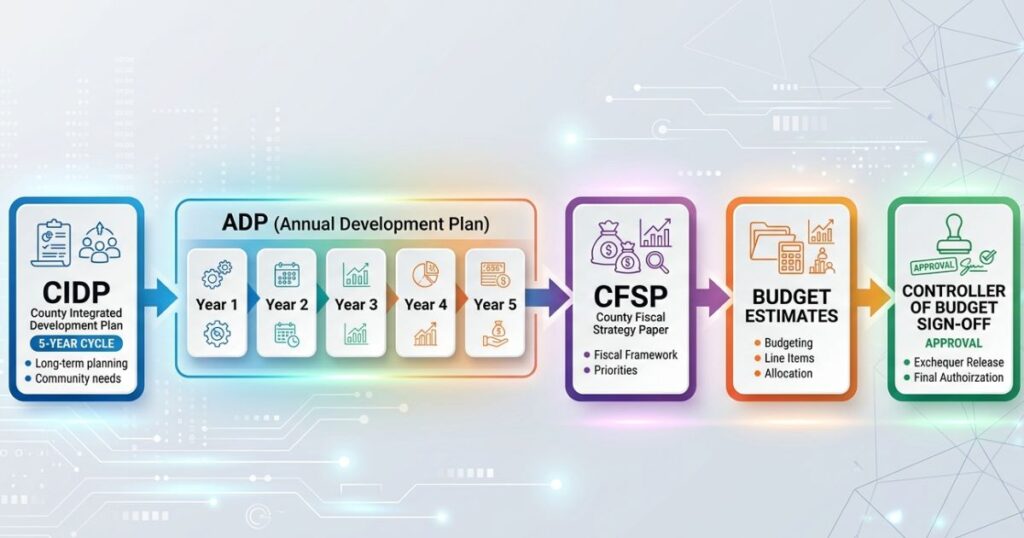
The chain runs in one direction only: CIDP → ADP → CFSP → Budget. You can’t reverse it. A county that prepares a budget without first aligning it to the ADP, which in turn must align to the CIDP, is in legal violation and that’s exactly the audit finding that drives “qualified” or “disclaimer” opinions from the Controller of Budget.
Here’s the thing: many county officers understand the CIDP and the budget as two separate processes. They’re not. The ADP is the annual implementation instrument of the CIDP, and the budget is the financial expression of the ADP. Break the chain anywhere and the whole accountability framework collapses.
What the 2023–2027 Generation (CIDP III) Changed
This is the third generation of CIDPs since devolution began in 2013. The first cycle covered 2013–2017. The second, 2018–2022. Each generation has been guided by updated national planning frameworks.
CIDP III is different in three concrete ways
- Alignment to MTP IV’s theme: The Fourth Medium Term Plan’s theme is “Accelerating Socio-Economic Transformation to a more Competitive, Inclusive and Resilient Economy.” Every CIDP III is expected to articulate how county-level programmes contribute to this national theme not just reference it in a table.
- Mandatory integration of population dynamics: The August 2022 guidelines include a new annex Annex 3 specifically on integrating population issues into the CIDP. Demographic transition, age structure shifts, fertility and mortality data from the 2019 Census all have to appear explicitly in the development analysis, not as background statistics but as drivers of planning decisions.
- Climate and SDG obligations are now structural, not optional: Previous CIDPs often treated SDGs and the Paris Agreement as appendix items. CIDP III guidelines require that they appear as integrated threads across sector chapters particularly in agriculture, water, and infrastructure planning.
Some experts argue that the uniformity these guidelines impose risks flattening local context. That’s valid for counties with genuinely unusual geographies Lamu’s coastal marine economy and Isiolo’s arid rangeland economy face different planning challenges than Nairobi’s urban density. But the counter-argument is stronger: without baseline uniformity, inter-county benchmarking is impossible, and Kenya’s devolution oversight bodies the Controller of Budget, the Commission on Revenue Allocation, and Constitutional Commissions can’t hold counties to consistent standards.
How to Analyse a CIDP: The IBP Kenya Framework
The International Budget Partnership (IBP) Kenya has produced one of the most practical tools available for anyone who needs to read, validate, or contribute to a CIDP a nine-question analysis guide that works whether or not a CIDP is already available.
To analyse a county integrated development plan using the IBP framework, follow these steps:
- Check whether the CIDP reviews the previous plan period and draws clear lessons from it
- Verify that a realistic development strategy with a theory of change is present
- Confirm that sector programmes and flagship projects are explicitly costed
- Assess whether the resource mobilisation framework is credible and county-specific
- Examine whether the M&E chapter contains measurable indicators with clear baselines
- Check for genuine public participation evidence not just a list of meetings held
Most CIDPs pass questions 1 through 3. Questions 4 through 6 are where the real gaps appear. I’ve seen conflicting readings on this some analysts say Kenya counties have improved significantly on M&E since CIDP I; others point to the Controller of Budget’s persistent finding that development expenditure absorption across counties rarely exceeds 70–75%. My read is that the plan quality has improved, but implementation tracking remains the weak link.
Read more: IBP Kenya CIDP guide
Common Mistakes in CIDP Preparation (And Why They’re Costly)
Look if you’re a planning officer contributing to a CIDP for the first time, here’s what actually trips people up.
Treating public participation as a box-ticking exercise
The guidelines require participatory preparation. Counties that reduce this to one poorly attended public forum end up with a plan that doesn’t reflect ward-level priorities and then face pushback during ADP preparation when communities point out that their priorities never made it into the document.
Copying the previous CIDP’s chapter structure without updating the baseline
The 2019 Census changed population figures for nearly every county. A CIDP III that still cites 2009 Census data in Chapter 1 fails on its own terms.
Weak resource mobilisation frameworks
OSR projections that simply increase by a flat percentage each year without explaining which revenue streams will grow and why are a common audit red flag. A 2018 World Bank and National Treasury study found that counties collectively collected roughly half their OSR potential; a credible CIDP should engage with that gap specifically, not generically.
Flagship projects without costing
Chapter 4 projects that lack timelines, responsible institutions, and indicative budgets can’t be tracked, can’t be budgeted for in ADPs, and can’t be reported on to the County Assembly.
This guide covers the CIDP framework as it applies to county executive governments under the County Government Act, 2012. County Assembly CIDPs follow the same legal obligation but differ in functional scope. For sector-specific plans, spatial plans, and city/municipal plans, refer to the relevant sectoral guidance from the State Department for Planning.
FAQs
What is a county integrated development plan in Kenya?
It’s a legally required five-year plan every county must have before spending public funds. It sets priorities, programmes, budgets, and monitoring targets. Sections 104 and 108 of the County Government Act, 2012 make it mandatory.
How many chapters does a CIDP have?
The standard CIDP has six chapters: county overview, performance review of the previous CIDP, spatial framework, sector priorities, implementation framework, and monitoring and evaluation.
What’s the difference between a CIDP and an annual development plan?
The CIDP covers five years and sets strategic direction. The annual development plan implements the CIDP one year at a time. Without an approved CIDP, no ADP and no county budget can be legally prepared.
When was the current CIDP cycle prepared?
Kenya’s third generation of CIDPs covers 2023–2027. Counties prepared these following guidelines issued by the State Department for Planning in August 2022.
Where can I download official CIDP documents for all 47 counties?
The Council of Governors’ Maarifa Centre (maarifa.cog.go.ke) and individual county government websites are the primary sources. The State Department for Devolution also hosts older CIDP cycles.
