


Music notes names are the starting point of understanding how music really works. Every song you hear is built from simple notes that musicians use to create melody and harmony. Learning these note names helps beginners read music, play instruments, and follow rhythms more easily. From the basic A, B, C notes to the familiar Do, Re, Mi system, each note has its place in music. Once you understand music notes names, the whole world of music begins to make much more sense.
Music Notes Names and Their Meanings Explained
- C – Often considered the starting point of the musical scale, representing balance and simplicity.
- D – A note associated with movement and progression in melodies.
- E – Known for its bright and expressive sound in many compositions.
- F – A note that adds depth and emotional color to music.
- G – Commonly used to create strong harmonic foundations.
- A – A warm and resonant note frequently used for tuning instruments.
- B – A note that creates tension and anticipation before resolving to C.
- C Sharp – A slightly higher pitch than C that adds intensity to melodies.
- D Sharp – A sharp note that brings brightness and energy.
- F Sharp – Often used in expressive musical passages.
- G Sharp – A note that adds richness and smooth transition between tones.
- A Sharp – A powerful note that enhances harmonic tension.
- D Flat – A softer variation of C sharp used in many classical pieces.
- E Flat – A mellow note often found in jazz and orchestral music.
- G Flat – A deep sounding note that provides smooth tonal movement.
- A Flat – Known for its warm and emotional tone.
- B Flat – A commonly used note in brass and band music.
- Whole Note – A note that lasts for four beats in common time.
- Half Note – A note held for two beats in most musical rhythms.
- Quarter Note – One of the most common notes, lasting one beat.
- Eighth Note – A note that lasts half a beat in standard timing.
- Sixteenth Note – A quick note used in fast musical passages.
- Thirty Second Note – A very short note used for rapid musical runs.
- Sixty Fourth Note – An extremely brief note in very fast sections.
- Double Whole Note – A note held for eight beats.
- Dotted Half Note – A half note extended by half its value.
- Dotted Quarter Note – A quarter note held for one and a half beats.
- Dotted Eighth Note – A rhythmic note that lasts three quarters of a beat.
- Triplet Note – Three notes played evenly within the space of two.
- Grace Note – A quick ornamental note played before the main note.
- Tie – Connects two notes to create a longer continuous sound.
- Slur – Indicates smooth and connected playing between notes.
- Rest – A symbol representing silence in music.
- Whole Rest – A full measure of silence in common time.
- Half Rest – Silence lasting two beats.
- Quarter Rest – A pause lasting one beat.
- Eighth Rest – A short pause lasting half a beat.
- Sixteenth Rest – A very quick pause in rhythm.
- Natural Note – A note played without sharp or flat alteration.
- Sharp Note – Raises the pitch of a note by a half step.
- Flat Note – Lowers the pitch of a note by a half step.
- Accidental – A symbol that temporarily changes a note’s pitch.
- Ledger Note – A note written above or below the staff lines.
- Root Note – The foundational note of a chord.
- Leading Tone – A note that naturally resolves to the tonic.
- Tonic Note – The central and most stable note in a scale.
- Dominant Note – The fifth note of a scale that creates tension.
- Subdominant Note – The fourth note of a scale that supports harmony.
- Octave Note – A note that has double or half the frequency of another.
- Chromatic Note – Any note that belongs to the full set of twelve pitches.
- Enharmonic Note – Two differently named notes that sound the same pitch.
Music Notes Names Every Beginner Should Know
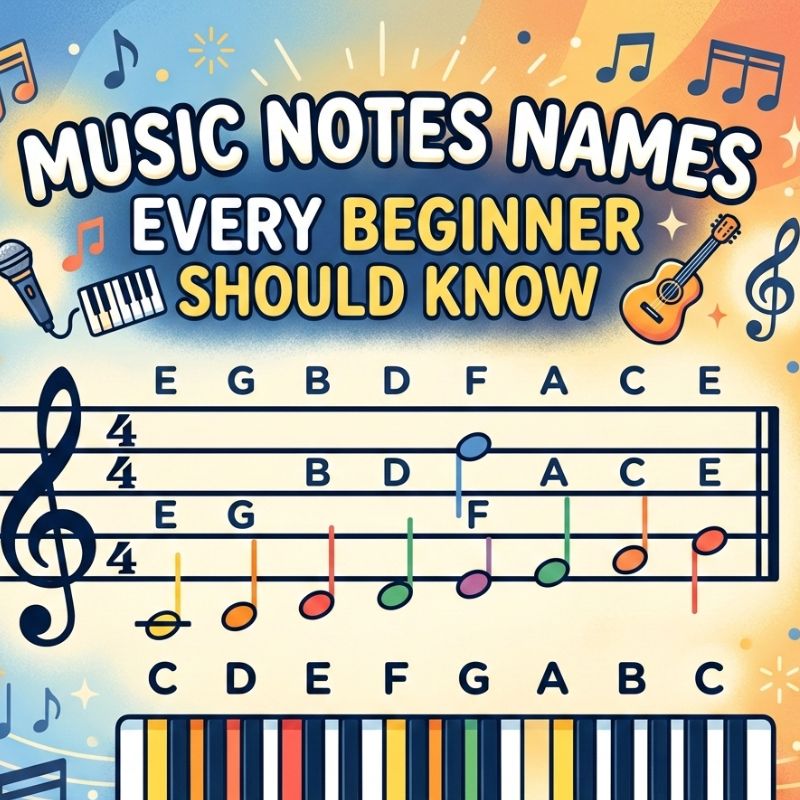
- C
- D
- E
- F
- G
- A
- B
- C Sharp
- D Sharp
- F Sharp
- G Sharp
- A Sharp
- D Flat
- E Flat
- G Flat
- A Flat
- B Flat
- Middle C
- High C
- Low C
- Whole Note
- Half Note
- Quarter Note
- Eighth Note
- Sixteenth Note
- Thirty Second Note
- Sixty Fourth Note
- Double Whole Note
- Dotted Whole Note
- Dotted Half Note
- Dotted Quarter Note
- Dotted Eighth Note
- Triplet Note
- Grace Note
- Tied Note
- Slurred Note
- Natural Note
- Sharp Note
- Flat Note
- Accidental Note
- Rest Note
- Whole Rest
- Half Rest
- Quarter Rest
- Eighth Rest
- Sixteenth Rest
- Ledger Line Note
- Octave Note
- Root Note
- Tonic Note
- Dominant Note
- Subdominant Note
Music Notes Names in Order from A to G
- A
- A Sharp
- A Flat
- A Natural
- A Double Sharp
- A Double Flat
- A Octave
- A Major Note
- A Minor Note
- A Harmonic Note
- B
- B Sharp
- B Flat
- B Natural
- B Double Sharp
- B Double Flat
- B Octave
- B Major Note
- B Minor Note
- B Harmonic Note
- C
- C Sharp
- C Flat
- C Natural
- C Double Sharp
- C Double Flat
- C Octave
- D
- D Sharp
- D Flat
- D Natural
- D Double Sharp
- D Double Flat
- D Octave
- E
- E Sharp
- E Flat
- E Natural
- E Double Sharp
- E Double Flat
- E Octave
- F
- F Sharp
- F Flat
- F Natural
- F Double Sharp
- F Double Flat
- F Octave
- G
- G Sharp
- G Flat
- G Natural
- G Double Sharp
- G Double Flat
- G Octave
Music Notes Names on the Piano and How They Work
- C – The white key that often serves as the starting point of the C major scale.
- C Sharp – The black key immediately to the right of C, raises the pitch by a half step.
- D – The white key between C and E, creating a major second interval from C.
- D Sharp – The black key immediately to the right of D, adds brightness to melodies.
- E – The white key after D, often used in major and minor scales.
- F – The white key after E, foundation for many chords.
- F Sharp – The black key to the right of F, adds tension and color.
- G – The white key after F, central in creating harmony.
- G Sharp – The black key to the right of G, often used in modulation.
- A – The white key after G, resonant and commonly used for tuning.
- A Sharp – The black key to the right of A, sharpens melodies and harmonies.
- B – The white key after A, creates leading tones toward C.
- C (Octave Higher) – Repeats the same note in higher pitch, creating an octave.
- Middle C – The central C on the piano, reference point for beginners.
- Whole Note – Played and held for four beats, occupying space across the piano.
- Half Note – Held for two beats, often forming the backbone of melodies.
- Quarter Note – Lasts one beat, frequently used in rhythm exercises.
- Eighth Note – Short note lasting half a beat, used for faster passages.
- Sixteenth Note – Very quick note, adds rhythmical complexity.
- Thirty Second Note – Extremely fast note for advanced passages.
- Sixty Fourth Note – Rare, ultra-fast note for technical exercises.
- Double Whole Note – Held for eight beats, rarely used but foundational in theory.
- Dotted Whole Note – Extends a whole note by half its duration, creating longer tones.
- Dotted Half Note – Adds half the value of a half note, giving sustained sound.
- Dotted Quarter Note – Quarter note extended, common in piano melodies.
- Dotted Eighth Note – Quick note held for three-quarters of a beat, adds swing.
- Triplet Note – Three notes played evenly in the space of two beats.
- Grace Note – Quick ornamental note played just before the main note.
- Tie – Connects two notes to sustain sound across keys.
- Slur – Smooth connection between notes, guiding finger movement.
- Rest – Symbol of silence, crucial for rhythm.
- Whole Rest – Full measure of silence.
- Half Rest – Silence for two beats.
- Quarter Rest – Silence for one beat.
- Eighth Rest – Short silence lasting half a beat.
- Sixteenth Rest – Very brief pause in fast passages.
- Ledger Line Note – Notes that extend above or below the standard staff, important for piano ranges.
- Root Note – The main note of a chord, forming the base of harmony.
- Tonic Note – Central note of a scale, often C for piano beginners.
- Dominant Note – Fifth note of a scale, creating tension for resolution.
- Subdominant Note – Fourth note of a scale, supports harmonic movement.
- Octave Note – Same note at double or half the frequency.
- Chromatic Note – Any note in the 12-note piano system, black or white.
- Enharmonic Note – Notes with different names but identical pitch on the keyboard.
- Natural Note – White key played without alteration.
- Sharp Note – Raises the pitch by a half step, often black keys.
- Flat Note – Lowers pitch by a half step, black keys in most cases.
- Accidental – Temporary pitch change, common in sheet music.
- Black Keys – Used for sharps and flats, essential for chromatic scales.
- White Keys – Represent natural notes from A to G.
- Pedal Use – Sustains notes to create continuous sound across the keyboard.
- Hand Position – Guides beginners on which notes to play smoothly.
- Finger Numbers – Helps coordinate which finger plays which note for technique.
Music Notes Names in Western Music Theory
- C – The foundational note in many scales, often considered the tonic of C major.
- C Sharp – Raises C by a half step, essential in chromatic passages.
- D – A natural note that forms the second degree of the C major scale.
- D Sharp – Enhances melodies by adding a sharp interval to D.
- E – The third degree in C major, creating major and minor chords.
- F – Fourth note in the C major scale, supports harmonic progressions.
- F Sharp – Adds tension and color in Western compositions.
- G – Fifth note in the scale, dominant in creating resolution.
- G Sharp – Sharpens the G note for chromatic and expressive use.
- A – Sixth degree in C major, commonly used for melodies.
- A Sharp – Raises A for modulations and chromatic scales.
- B – Seventh note in C major, acts as a leading tone to C.
- C (Octave) – Repeats the tonic an octave higher, maintaining harmonic consistency.
- Middle C – Central note on the piano, reference for pitch and staff.
- Whole Note – Held for four beats, providing a sense of stability.
- Half Note – Lasts two beats, commonly used in melodies and accompaniment.
- Quarter Note – One beat, forms the rhythmic backbone of most pieces.
- Eighth Note – Lasts half a beat, creates rhythmic movement.
- Sixteenth Note – Fast note for detailed ornamentation.
- Thirty Second Note – Extremely rapid note used in virtuosic passages.
- Sixty Fourth Note – Rare, ultra-fast note in advanced compositions.
- Double Whole Note – Held for eight beats, foundational in early Western music notation.
- Dotted Whole Note – Extends whole note by half its value, creating longer tones.
- Dotted Half Note – Half note extended by half its value, used for expressive phrasing.
- Dotted Quarter Note – Quarter note lengthened, adds syncopation.
- Dotted Eighth Note – Eighth note extended for rhythmic variation.
- Triplet Note – Three notes in the time of two, common in Western rhythms.
- Grace Note – Quick ornamental note before the main note.
- Tied Note – Connects two notes for sustained sound.
- Slur – Indicates legato playing between notes.
- Rest – Represents silence in compositions.
- Whole Rest – A full measure of silence.
- Half Rest – Silence lasting two beats.
- Quarter Rest – One beat of silence.
- Eighth Rest – Half beat pause.
- Sixteenth Rest – Very short rhythmic pause.
- Natural Note – A note without alteration, white key in piano context.
- Sharp Note – Raises a note by a semitone.
- Flat Note – Lowers a note by a semitone.
- Accidental – Symbol temporarily altering a note’s pitch.
- Root Note – The base note of a chord.
- Tonic Note – Central note of a scale, provides resolution.
- Dominant Note – Fifth note, creates tension for resolution.
- Subdominant Note – Fourth note, supports chord progression.
- Octave Note – Same pitch at higher or lower frequency.
- Chromatic Note – Any note in the twelve-tone Western system.
- Enharmonic Note – Notes with different names but identical pitch.
- Key Signature Note – Determines which notes are sharp or flat in a piece.
- Scale Degree Notes – Notes numbered according to their position in a scale.
- Leading Tone – Seventh scale degree resolving to tonic.
- Passing Tone – Non-chord tone connecting two chord tones.
- Neighbor Tone – Non-chord tone moving away and returning to chord tone.
- Suspension Note – Creates tension by holding a note into a new chord.
- Pedal Tone – Sustained note, usually in bass, around which harmonies change.
- Chord Tone – Notes that belong to the underlying chord.
- Non-Chord Tone – Notes outside the current chord, adding tension or ornamentation.
Read more: Best Funny Character Names That Will Make You Laugh 2026
Music Notes Names and Their Role in Reading Sheet Music
- C – The starting point for many scales, easy to locate on the staff.
- C Sharp – Indicates a raised C, essential for chromatic passages.
- D – The second note in C major, used frequently in melodies.
- D Sharp – Raises D for melodic and harmonic variation.
- E – Third note of C major, forms major and minor chords.
- F – Fourth note, often used in harmonies and chord progressions.
- F Sharp – Sharped F, used for tension and modulation.
- G – Fifth note, dominant in creating musical resolution.
- G Sharp – Enhances melodies by raising G.
- A – Sixth note, commonly featured in sheet music for phrasing.
- A Sharp – Raised A, used in chromatic and expressive passages.
- B – Seventh note, leads naturally back to C.
- Middle C – Reference note for beginners, central on both staff and piano.
- High C – C note an octave above middle C, used for higher melodies.
- Low C – C note an octave below middle C, adds depth to bass lines.
- Whole Note – A note held for four beats, provides visual stability on the staff.
- Half Note – Two-beat note, easy to recognize in sheet music.
- Quarter Note – One beat, most common note for rhythm and melody.
- Eighth Note – Half beat, creates rhythmic movement.
- Sixteenth Note – Fast note, adds intricate rhythms.
- Thirty Second Note – Very quick note, used in ornamentation.
- Sixty Fourth Note – Extremely short, used in advanced passages.
- Double Whole Note – Held for eight beats, seen in older sheet music.
- Dotted Whole Note – Extends a whole note by half its value.
- Dotted Half Note – Half note extended for expressive timing.
- Dotted Quarter Note – Quarter note lengthened for syncopation.
- Dotted Eighth Note – Eighth note extended, adds rhythmic interest.
- Triplet Note – Three notes evenly spaced in the duration of two.
- Grace Note – Quick note before the main note, adds ornamentation.
- Tied Note – Connects two notes to extend duration across the staff.
- Slur – Indicates smooth legato between notes, guides phrasing.
- Rest – Symbolizes silence, critical for rhythm interpretation.
- Whole Rest – Entire measure of silence.
- Half Rest – Two beats of silence.
- Quarter Rest – One beat of silence.
- Eighth Rest – Half-beat pause.
- Sixteenth Rest – Very short pause, adds rhythmic detail.
- Natural Note – Cancels previous sharps or flats, returns note to original pitch.
- Sharp Note – Raises pitch by a half step, critical for key signatures.
- Flat Note – Lowers pitch by a half step, alters melody and harmony.
- Accidental – Temporary pitch change outside the key signature.
- Root Note – Base of a chord, helps identify chord names.
- Tonic Note – Central note of a scale, key for tonal center.
- Dominant Note – Fifth note of a scale, creates tension to resolve.
- Subdominant Note – Fourth note, often leads to dominant chords.
- Octave Note – Same note in a higher or lower register, helps recognize patterns.
- Chromatic Note – Notes outside the diatonic scale, adds color to melodies.
- Enharmonic Note – Different name, same pitch, essential in reading alternate keys.
- Key Signature Note – Determines which notes are sharp or flat throughout the piece.
- Scale Degree Notes – Numbered notes in a scale, helps understand harmonic function.
- Leading Tone – Seventh note of a scale, resolves to tonic.
- Passing Tone – Non-chord note connecting two chord tones.
- Neighbor Tone – Non-chord note that moves away and returns to a chord tone.
- Suspension Note – Creates tension by holding a note into a new chord.
- Pedal Tone – Sustained note around which harmonies change, guides harmonic reading.
- Chord Tone – Note that belongs to the underlying chord, reinforces harmony.
- Non-Chord Tone – Note outside the chord, adds tension or melodic interest.
- Accented Note – Note played louder or emphasized, important for phrasing.
Music Notes Names with Examples for Beginners
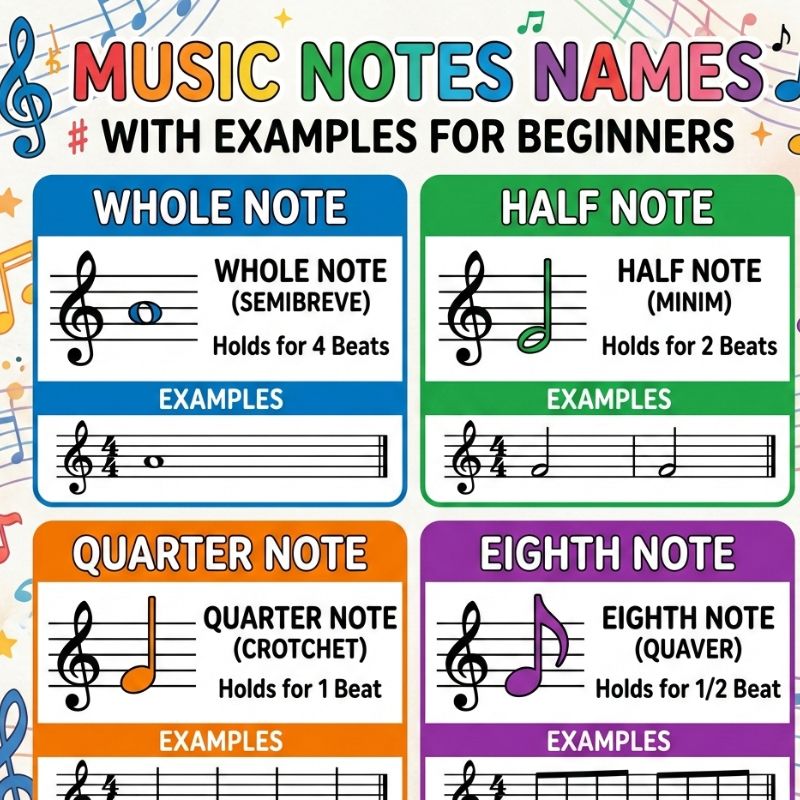
- C – Example: “Twinkle Twinkle Little Star” starts with C.
- D – Example: “Mary Had a Little Lamb” uses D after E.
- E – Example: “Ode to Joy” begins with E in the melody.
- F – Example: “Jingle Bells” has F in the chorus.
- G – Example: “Happy Birthday” starts with G for many lines.
- A – Example: “London Bridge” uses A in its opening notes.
- B – Example: “Baa Baa Black Sheep” includes B in the scale.
- C Sharp – Example: “Für Elise” starts with E but uses C sharp in the piece.
- D Sharp – Example: Found in chromatic runs in beginner piano pieces.
- F Sharp – Example: Appears in simple arrangements of “Greensleeves.”
- G Sharp – Example: Used in easier versions of “Minuet in G.”
- A Sharp – Example: Appears in beginner jazz piano exercises.
- D Flat – Example: Used interchangeably with C sharp in beginner songs.
- E Flat – Example: Found in simplified versions of “The Entertainer.”
- G Flat – Example: Appears in beginner arrangements for black keys practice.
- A Flat – Example: Simple melodies in beginner piano books.
- B Flat – Example: “Hot Cross Buns” can be played using B flat in some keys.
- Middle C – Example: The starting point for most beginner piano lessons.
- High C – Example: Used in simple octave exercises for beginners.
- Low C – Example: Helps beginners play left-hand bass notes.
- Whole Note – Example: Hold C for four beats in “Twinkle Twinkle Little Star.”
- Half Note – Example: Hold G for two beats in “Mary Had a Little Lamb.”
- Quarter Note – Example: Play each note in “Hot Cross Buns” as a quarter note.
- Eighth Note – Example: Use in “Jingle Bells” for faster note movement.
- Sixteenth Note – Example: Found in simple scale exercises for finger practice.
- Thirty Second Note – Example: Appears in beginner ornamentation exercises.
- Sixty Fourth Note – Example: Rare in beginner pieces, more for advanced practice.
- Double Whole Note – Example: Used in older beginner sheet music.
- Dotted Whole Note – Example: C held for six beats in beginner exercises.
- Dotted Half Note – Example: Hold F for three beats in “Ode to Joy.”
- Dotted Quarter Note – Example: Quarter note extended for rhythmic practice.
- Dotted Eighth Note – Example: Eighth note held longer in simple melodies.
- Triplet Note – Example: Three notes in the space of two in beginner exercises.
- Grace Note – Example: Small ornamental note in beginner piano pieces.
- Tied Note – Example: Connect two G notes across a measure in simple songs.
- Slur – Example: Play C to D smoothly in “Twinkle Twinkle Little Star.”
- Rest – Example: Pause for one beat in “Hot Cross Buns.”
- Whole Rest – Example: Silence for a full measure in beginner sheet music.
- Half Rest – Example: Pause for two beats in simple songs.
- Quarter Rest – Example: Pause for one beat in beginner exercises.
- Eighth Rest – Example: Short pause in “Jingle Bells” for rhythm practice.
- Sixteenth Rest – Example: Quick pause in scale exercises.
- Natural Note – Example: C natural in “Twinkle Twinkle Little Star.”
- Sharp Note – Example: C sharp in “Für Elise.”
- Flat Note – Example: B flat in “Hot Cross Buns” in certain keys.
- Accidental – Example: Any note with a sharp or flat not in the key signature.
- Root Note – Example: C is the root note of the C major chord.
- Tonic Note – Example: C serves as tonic in C major songs.
- Dominant Note – Example: G in C major creates resolution.
- Subdominant Note – Example: F leads naturally to G in beginner songs.
- Octave Note – Example: Play C in two octaves in simple exercises.
- Chromatic Note – Example: Notes between C and D in beginner chromatic scales.
- Enharmonic Note – Example: C sharp sounds the same as D flat in beginner exercises.
- Key Signature Note – Example: F sharp appears in the key of G major.
- Scale Degree Notes – Example: First note C, second note D in C major scale.
- Leading Tone – Example: B leading back to C in simple melodies.
- Passing Tone – Example: D used between C and E in beginner songs.
- Neighbor Tone – Example: D moving to C and back in simple exercises.
- Suspension Note – Example: F held before resolving to E in basic arrangements.
- Pedal Tone – Example: Hold C in the bass while playing melody notes.
- Chord Tone – Example: C, E, G in C major chord for beginners.
- Non-Chord Tone – Example: D in C major used as a passing note.
- Accented Note – Example: Play G louder in “Twinkle Twinkle Little Star.”
Music Notes Names and the Do Re Mi Solfège System
- C – Do, the tonic of the C major scale.
- D – Re, the second note, creating stepwise motion from Do.
- E – Mi, the third note, forming the major triad with Do and Sol.
- F – Fa, the fourth note, leading into Sol and creating subdominant harmony.
- G – Sol, the fifth note, dominant note creating tension toward Do.
- A – La, the sixth note, adding warmth and melodic flow.
- B – Ti, the seventh note, leading tone resolving to Do.
- C (Octave) – Do, repeating the tonic an octave higher.
- C Sharp – Di, raised Do in chromatic Solfège exercises.
- D Sharp – Ri, raised Re for chromatic melodies.
- F Sharp – Fi, raised Fa, adding chromatic color.
- G Sharp – Si, raised Sol, used in chromatic passages.
- A Sharp – Li, raised La in chromatic Solfège practice.
- D Flat – Ra, lowered Re for minor scale variations.
- E Flat – Me, lowered Mi in minor melodies.
- G Flat – Se, lowered Sol for chromatic progressions.
- A Flat – Le, lowered La in minor scales.
- B Flat – Te, lowered Ti for chromatic leading tones.
- Whole Note – Held Do, Re, Mi, or any note for four beats.
- Half Note – Sustained Sol or Fa for two beats.
- Quarter Note – Do, Re, Mi for one beat each.
- Eighth Note – Faster notes like Do Re or Mi Fa in half beats.
- Sixteenth Note – Rapid Sol La sequences in advanced exercises.
- Thirty Second Note – Very quick Re Mi passages in chromatic drills.
- Sixty Fourth Note – Extremely fast Do Re Mi for advanced technique.
- Double Whole Note – Held Do or Sol for eight beats in exercises.
- Dotted Whole Note – Extended Do or Mi for six beats.
- Dotted Half Note – Sustained Fa or La for three beats.
- Dotted Quarter Note – Extended Re or Sol for rhythmic variety.
- Dotted Eighth Note – Quick La or Ti held slightly longer.
- Triplet Note – Do Re Mi played in triplet rhythm.
- Grace Note – Quick ornament like a fast Re before Mi.
- Tied Note – Connects Do across measures for sustained pitch.
- Slur – Smooth Do Re Mi transitions for legato practice.
- Rest – Silence between Do, Re, or Mi notes.
- Whole Rest – Pause for full measure in Solfège exercises.
- Half Rest – Silence for two beats, often after Sol or Fa.
- Quarter Rest – One beat pause for rhythmic accuracy.
- Eighth Rest – Short pause between quick notes like Re Mi.
- Sixteenth Rest – Very brief pause in fast Do Re sequences.
- Natural Note – Do, Re, Mi without alteration in key signature.
- Sharp Note – Di, Ri, Fi, Si, Li for chromatic practice.
- Flat Note – Ra, Me, Se, Le, Te for chromatic variations.
- Accidental – Any temporary sharp or flat in Solfège context.
- Root Note – Do as the foundation of chords and scales.
- Tonic Note – Do, central pitch in Solfège and melody.
- Dominant Note – Sol, fifth scale degree creating tension.
- Subdominant Note – Fa, fourth degree supporting harmony.
- Octave Note – Higher or lower Do repeating tonic.
- Chromatic Note – Notes like Di, Ri, Fi, Si, Li adding color.
- Enharmonic Note – Notes like Di and Ra sounding the same in exercises.
- Key Signature Note – Determines which Do, Re, Mi are sharp or flat.
- Scale Degree Notes – Do, Re, Mi, Fa, Sol, La, Ti, mapping all seven degrees.
- Leading Tone – Ti resolving naturally to Do in melodies.
- Passing Tone – Re used to connect Do and Mi in practice.
- Neighbor Tone – Mi moving to Re and back to Do.
- Suspension Note – Fa held before resolving to Mi.
- Pedal Tone – Do sustained in bass while singing Re Mi melody.
- Chord Tone – Do, Mi, Sol forming basic triads.
- Non-Chord Tone – Notes like Re between Do and Mi for melodic movement.
- Accented Note – Emphasized Sol or Ti in rhythmic Solfège exercises.
Music Notes Names Across Different Musical Scales
- C – Tonic of C major, starting point of many melodies.
- D – Second degree in C major and part of D minor scale.
- E – Third degree in C major, also major third in A minor.
- F – Fourth degree in C major and part of F major scale.
- G – Fifth degree in C major, dominant in many keys.
- A – Sixth degree in C major, tonic of A minor scale.
- B – Seventh degree in C major, leading tone to C.
- C Sharp – Tonic of C sharp major, raises C in chromatic scales.
- D Sharp – Found in D sharp major and harmonic minor scales.
- F Sharp – Appears in G major and D major scales.
- G Sharp – Present in A major and E major scales.
- A Sharp – Used in B major and E major scales.
- D Flat – Enharmonic of C sharp, found in D flat major.
- E Flat – Third degree of C minor and tonic of E flat major.
- G Flat – Part of G flat major and B flat minor scales.
- A Flat – Fourth degree in E flat major and tonic of A flat major.
- B Flat – Second degree in A flat major and tonic of B flat major.
- Middle C – Central note in most scales, reference point.
- High C – Octave higher C in various scale exercises.
- Low C – Bass C in minor and major scales.
- Whole Note – Used for tonic or other scale degrees for full measure.
- Half Note – Holds scale notes for two beats in practice.
- Quarter Note – Standard note for melodies in all scales.
- Eighth Note – Used for faster scale passages.
- Sixteenth Note – Adds speed and complexity in scale runs.
- Thirty Second Note – Appears in advanced scale exercises.
- Sixty Fourth Note – Rarely used, fast chromatic or scale sequences.
- Double Whole Note – Extended tonic or dominant note.
- Dotted Whole Note – Used for longer sustained scale degrees.
- Dotted Half Note – Extends main notes in beginner scales.
- Dotted Quarter Note – Adds syncopation in scale practice.
- Dotted Eighth Note – Quick rhythmic variations in scales.
- Triplet Note – Three notes in the space of two in scale drills.
- Grace Note – Ornamental note before main scale degree.
- Tied Note – Connects scale notes across measures.
- Slur – Smooth legato across scale passages.
- Rest – Silence between scale exercises.
- Whole Rest – Full measure pause in scale practice.
- Half Rest – Two beats of rest between exercises.
- Quarter Rest – One beat of pause in scale sequences.
- Eighth Rest – Half beat pause in faster scales.
- Sixteenth Rest – Quick pause in intricate scale runs.
- Natural Note – Notes without alterations in diatonic scales.
- Sharp Note – Raised notes in major, minor, and chromatic scales.
- Flat Note – Lowered notes in minor and modal scales.
- Accidental – Temporary sharp or flat altering scale notes.
- Root Note – Foundational note of any scale.
- Tonic Note – Central pitch defining the scale.
- Dominant Note – Fifth degree providing tension and resolution.
- Subdominant Note – Fourth degree, supporting harmonic movement.
- Octave Note – Same scale degree an octave higher or lower.
- Chromatic Note – Notes outside the main diatonic scale.
- Enharmonic Note – Same sounding note with different names in scales.
- Key Signature Note – Determines sharps and flats for the scale.
- Scale Degree Notes – Numbered notes defining position within any scale.
- Leading Tone – Seventh degree resolving to tonic.
- Passing Tone – Non-chord scale note connecting two scale degrees.
- Neighbor Tone – Note moving away and returning within the scale.
- Suspension Note – Scale note held before resolving to a chord tone.
- Pedal Tone – Sustained note supporting scale harmony.
- Chord Tone – Notes forming chords within the scale.
- Non-Chord Tone – Notes outside the main chord for melodic movement.
- Accented Note – Emphasized scale note for rhythm and phrasing.
Music Notes Names and How They Build Melody and Harmony
- C – Serves as the tonic, forming the foundation of melodies and chords.
- D – Adds movement from C to E, creating stepwise melodic flow.
- E – Completes the C major triad with C and G, forming harmony.
- F – Provides subdominant harmony, often leading to G or C.
- G – Dominant note, creates tension that resolves to C.
- A – Adds melodic warmth and forms minor chords in harmony.
- B – Leading tone, resolves upward to C, enhancing melodic direction.
- C Sharp – Chromatic alteration, adds tension or color to melodies.
- D Sharp – Brightens passages, often used in modulation.
- F Sharp – Creates harmonic variety and tension in progressions.
- G Sharp – Adds dissonance and chromatic movement in harmony.
- A Sharp – Enhances dominant function in certain keys.
- D Flat – Softens melodies and adds chromatic depth.
- E Flat – Creates minor tonal color and smooth harmonic transitions.
- G Flat – Adds tension and richness in chord progressions.
- A Flat – Contributes to minor harmonies and melodic color.
- B Flat – Often used in dominant seventh chords for harmonic interest.
- Middle C – Reference pitch for melody and chord positioning.
- High C – Extends melodies upward, creating range in harmony.
- Low C – Supports bass lines and harmonic foundation.
- Whole Note – Sustains a pitch, allowing harmonies to resonate.
- Half Note – Holds notes to support melodic phrases.
- Quarter Note – Provides rhythm to melodies and harmonic patterns.
- Eighth Note – Adds movement and melodic detail.
- Sixteenth Note – Enables rapid melodic runs and embellishments.
- Thirty Second Note – Used for quick decorative notes in melody.
- Sixty Fourth Note – Very fast note for ornamentation and harmonic tension.
- Double Whole Note – Extended tonic or chord note for harmonic support.
- Dotted Whole Note – Sustains melody and harmonic tension.
- Dotted Half Note – Provides rhythm and harmonic weight.
- Dotted Quarter Note – Adds syncopation in melodic and harmonic lines.
- Dotted Eighth Note – Short extension for rhythmically interesting passages.
- Triplet Note – Creates rhythmic variation in melody and harmony.
- Grace Note – Ornament before main note, enhancing melodic expression.
- Tied Note – Connects notes across measures, sustaining harmony.
- Slur – Smooths melodic movement, aiding harmonic flow.
- Rest – Silence that shapes melody and emphasizes harmony.
- Whole Rest – Full measure of pause in melodic phrasing.
- Half Rest – Two-beat silence to accent melody.
- Quarter Rest – One-beat pause within a phrase.
- Eighth Rest – Half-beat pause in faster melodies.
- Sixteenth Rest – Quick pause in ornamented melodies.
- Natural Note – Returns melody to unaltered pitch, stabilizing harmony.
- Sharp Note – Raises pitch for tension, leading tones, and chromaticism.
- Flat Note – Lowers pitch to create minor harmonies or modal variation.
- Accidental – Temporary alteration of melody or harmony for color.
- Root Note – Foundation of chords and harmony.
- Tonic Note – Central note anchoring melodies and harmonic resolution.
- Dominant Note – Fifth scale degree, building tension toward tonic.
- Subdominant Note – Fourth scale degree, supports chord movement.
- Octave Note – Repeats melody at higher or lower pitch, enriching harmony.
- Chromatic Note – Adds color and complexity to melody and chords.
- Enharmonic Note – Same sounding note with different names for harmonic variety.
- Key Signature Note – Determines tonal center for melody and harmony.
- Scale Degree Notes – Positions within a scale that guide melody and chords.
- Leading Tone – Resolves to tonic, creating strong melodic direction.
- Passing Tone – Connects chord tones, enriching melodic flow.
- Neighbor Tone – Moves away and returns, adding melodic interest.
- Suspension Note – Holds tension before resolving, enhancing harmonic motion.
- Pedal Tone – Sustained note in bass, grounding melody and chords.
- Chord Tone – Forms the backbone of harmony.
- Non-Chord Tone – Adds dissonance and interest in melodic lines.
- Accented Note – Emphasizes melodic or harmonic movement.
Conclusion
Learning music notes names is one of the most important first steps in understanding music. These simple symbols and sounds are the building blocks behind every song, from classical masterpieces to modern hits. When you recognize how notes work together, reading sheet music and playing instruments becomes much easier. With practice, the notes start to feel natural, almost like a second language. No matter your instrument or skill level, mastering note names will always strengthen your musical journey and deepen your appreciation for music.
FAQs
What are music notes names?
Music notes names are the basic labels used to identify different sounds in music. In Western music, the primary note names are A, B, C, D, E, F, and G. These notes repeat in a pattern across instruments like piano, guitar, and violin. They help musicians read sheet music, understand melodies, and communicate musical ideas clearly. Once you understand note names, it becomes much easier to follow musical compositions and learn new songs.
Why is it important to learn music notes names?
Learning music notes names is important because they form the foundation of music theory and performance. When musicians know the names of notes, they can read sheet music, play instruments more accurately, and understand how melodies and chords are structured. It also helps with ear training and musical creativity. Whether you are a beginner or an advanced musician, knowing note names makes learning music faster and more enjoyable.
How many music notes are there in total?
In basic Western music, there are seven main note names: A, B, C, D, E, F, and G. However, when you include sharps and flats, the total becomes twelve notes within an octave. These twelve notes repeat across higher and lower pitches on instruments. This repeating system allows musicians to create countless melodies and harmonies while still using the same core set of notes.
What is the difference between note names and solfège?
Note names like A, B, C, D, E, F, and G are used mainly in Western music notation to identify pitches. Solfège, on the other hand, uses syllables such as Do, Re, Mi, Fa, Sol, La, and Ti to help singers and musicians train their ears. Both systems represent the same musical sounds but are used in slightly different ways for learning, teaching, and performing music.
Can beginners learn music notes names quickly?
Yes, beginners can learn music notes names quite quickly with consistent practice. Many students start by memorizing the seven basic notes and then identifying them on instruments like the piano or guitar. Using flashcards, music apps, and simple songs can also make the process easier. With regular practice, most learners become comfortable recognizing note names within a short time.
